

Radio and Television Broadcasting and Wireless Communications Equipment Manufacturing
Manufacturers of radio, television, and wireless communications equipment take custom and repeat orders for transmitters, receivers, antennas, amplifiers and related assemblies. Orders are turned into bills of materials, production schedules, test plans and shipping instructions. Component sourcing, regulatory certifications, inventory of long-lead parts, assembly sequences, quality testing and compliance paperwork remain with engineering and production staff.
What makes this business different
- Custom configurations with specific frequency bands, power levels, modulation types and connector options that must match customer specifications exactly
- Long-lead electronic components requiring forecast-based purchasing and safety stock
- Strict assembly sequences with electrostatic discharge controls and clean-room practices where needed
- Regulatory type acceptance, emissions testing and labeling for FCC, Industry Canada or CE marking
- Serial number tracking, firmware flashing and final acceptance test data for each unit
- Mix of make-to-order and make-to-stock production with kanban for common subassemblies
- Customer-supplied drawings, non-disclosure agreements and revision-controlled documentation
- Export licensing checks and end-user verification for controlled radio frequency hardware
Specialist bots

Order Configurator
Convert incoming customer orders into validated manufacturing specifications.
Works in: Ambitious Tasks, Ambitious Docs, Contract Analyzer · Workflows: Order intake and configuration validation
Automates
- Reads purchase orders and extracts model, frequency, power and option codes
- Validates configuration against product rule sets
- Checks component availability and lead times
- Drafts the order acknowledgment
- Creates the master production task
Stops for a person
- Engineering reviews and approves any non-standard configurations
- Export compliance screening is completed by a person
- A person sends the final order confirmation to the customer

Bill of Materials Engineer
Generate accurate revision-controlled bills of materials and assembly packages.
Works in: Ambitious Docs, Ambitious Sheets, Ambitious Tasks · Workflows: Bill of materials and revision control
Automates
- Pulls latest drawings and schematics from the vault
- Builds the indented bill of materials
- Attaches assembly notes and required firmware
- Flags long-lead and custom parts
Stops for a person
- Engineering signs off on the released bill of materials
- Any substitutions are approved by the responsible engineer

Procurement Coordinator
Maintain component inventory, generate purchase needs and track long-lead items.
Works in: Ambitious Sheets, Ambitious Tasks, Ambitious Docs · Workflows: Component procurement and inventory
Automates
- Explodes bills of materials against current stock
- Creates purchase requisitions by supplier
- Monitors lead times and obsolescence notices
- Updates safety stock recommendations
Stops for a person
- Purchasing places all orders and approves expenditures
- Incoming material inspection results are reviewed by quality staff
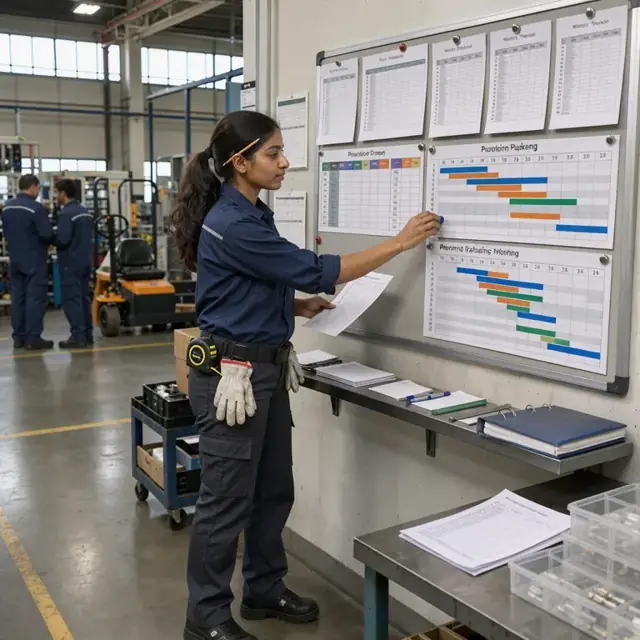
Production Scheduler
Build and balance the master production schedule across assembly and test resources.
Works in: Process Optimizer, Ambitious Tasks · Workflows: Production scheduling and capacity
Automates
- Loads confirmed orders into the schedule
- Sequences operations by due dates and resource availability
- Highlights capacity bottlenecks
- Releases work orders with travelers
Stops for a person
- Production manager approves the weekly schedule
- Overtime and outsourcing decisions are made by people

Test and Quality Technician
Create test plans, record results and manage non-conforming units.
Works in: Ambitious Tasks, Ambitious Docs, Ambitious Sheets · Workflows: Assembly test and quality
Automates
- Generates unit-specific test scripts and checklists
- Compiles serial number and test data records
- Routes failed units to rework with failure notes
- Prepares final test report packages
Stops for a person
- Certified technicians perform the actual radio frequency testing
- Engineering reviews test data for first-article units
- Quality manager signs off on release

Regulatory Certification Clerk
Track regulatory requirements, prepare labels and maintain certification files.
Works in: Ambitious Docs, Ambitious Tasks, Contract Analyzer · Workflows: Regulatory certification and labeling
Automates
- Checks product configurations against certification matrices
- Drafts regulatory labels with correct identifiers
- Compiles technical files and test summaries
- Tracks certification renewal dates
Stops for a person
- The compliance engineer confirms which standards apply
- Final labels and declarations are reviewed before use
- People handle all submissions to regulatory bodies

Shipping and Fulfillment Coordinator
Prepare shipping documents, packing lists and customer notifications.
Works in: Ambitious Tasks, Ambitious Docs, Email Buckets · Workflows: Shipping and customer fulfillment
Automates
- Generates packing lists with serial numbers and test data
- Prepares export paperwork when flagged
- Creates carrier labels and notifications
- Sends customer shipment confirmations
Stops for a person
- A person verifies export compliance and end-user statements
- The owner approves any special shipping instructions
- Final packages are inspected before sealing
Workflows
Order intake and configuration validation
Starts when: A customer order arrives by portal, email or purchase order
- Parse the requested model, frequency range, power output, options and any special markings
- Validate configuration against approved product matrices and engineering rules
- Check lead times for long-lead components and confirm feasible ship date
- Draft order acknowledgment with price, schedule and terms
- Create a manufacturing task with full bill-of-materials and test requirements
Watch for: Frequency and power combinations must be pre-certified or flagged for new testing; Export-controlled items require additional screening before acceptance
Bill of materials and revision control
Starts when: New or revised order is confirmed
- Pull latest approved revision of schematics and drawings
- Generate a complete indented bill of materials with part numbers and quantities
- Flag any customer-specific or long-lead items
- Attach assembly instructions and firmware version requirements
- Release the controlled package to production
Watch for: Engineering must approve any deviation from the master bill of materials; Revision history must be maintained for traceability
Component procurement and inventory
Starts when: After order confirmation and on a weekly cadence
- Explode the bill of materials against current inventory
- Generate purchase requisitions for shortages and forecast items
- Track supplier lead times and update safety stock levels for common parts
- Monitor component obsolescence alerts
- Receive and inspect incoming materials with lot traceability
Watch for: Certain integrated circuits and radio modules have multi-month lead times; Static-sensitive and moisture-sensitive devices require special handling
Production scheduling and capacity
Starts when: Weekly and upon new confirmed orders
- Load new orders into the master schedule
- Sequence assembly and test operations by required ship dates
- Balance workload across surface-mount, hand-assembly and test stations
- Identify capacity constraints and suggest overtime or outsourcing
- Release work orders with traveler and test plan
Watch for: Test equipment availability limits daily throughput; Certain products require sequential burn-in and final calibration
Assembly test and quality
Starts when: Work order is released to the floor
- Generate assembly checklist and torque specifications
- Create test scripts for each unit's frequency, power, spurious emissions and modulation
- Record serial numbers, firmware versions and test data
- Flag units that fail and route to rework
- Prepare final test report package
Watch for: Each unit must be tested against the exact configuration ordered; Test data must be archived for regulatory audits
Regulatory certification and labeling
Starts when: Before first production run and on design changes
- Check if the configuration requires new emissions or safety testing
- Compile technical construction file and test reports
- Draft FCC, CE or other regulatory labels with correct identifiers
- Track expiration dates of existing certifications
- Prepare shipment compliance declarations
Watch for: The engineering team confirms which regulatory paths apply to each model; Changes in components can invalidate prior certifications
Shipping and customer fulfillment
Starts when: Units pass final acceptance test
- Generate packing list with serial numbers and test summaries
- Prepare export documentation and end-user statements when required
- Draft shipping labels and carrier notifications
- Send customer notification with tracking and support contacts
- Close the order and archive all production records
Watch for: Hazardous materials shipping rules apply to lithium batteries and certain transmitters; Customer approval of final test data may be required before release
Bot templates for this industry
Source: U.S. Small Business Administration, Office of Size Standards, Table of Small Business Size Standards Matched to North American Industry Classification System Codes, version March 2023 (effective 2023-03-17, NAICS 2022). Size standards are shown for reference only.